
Inherited Stories: Contemporary Voices
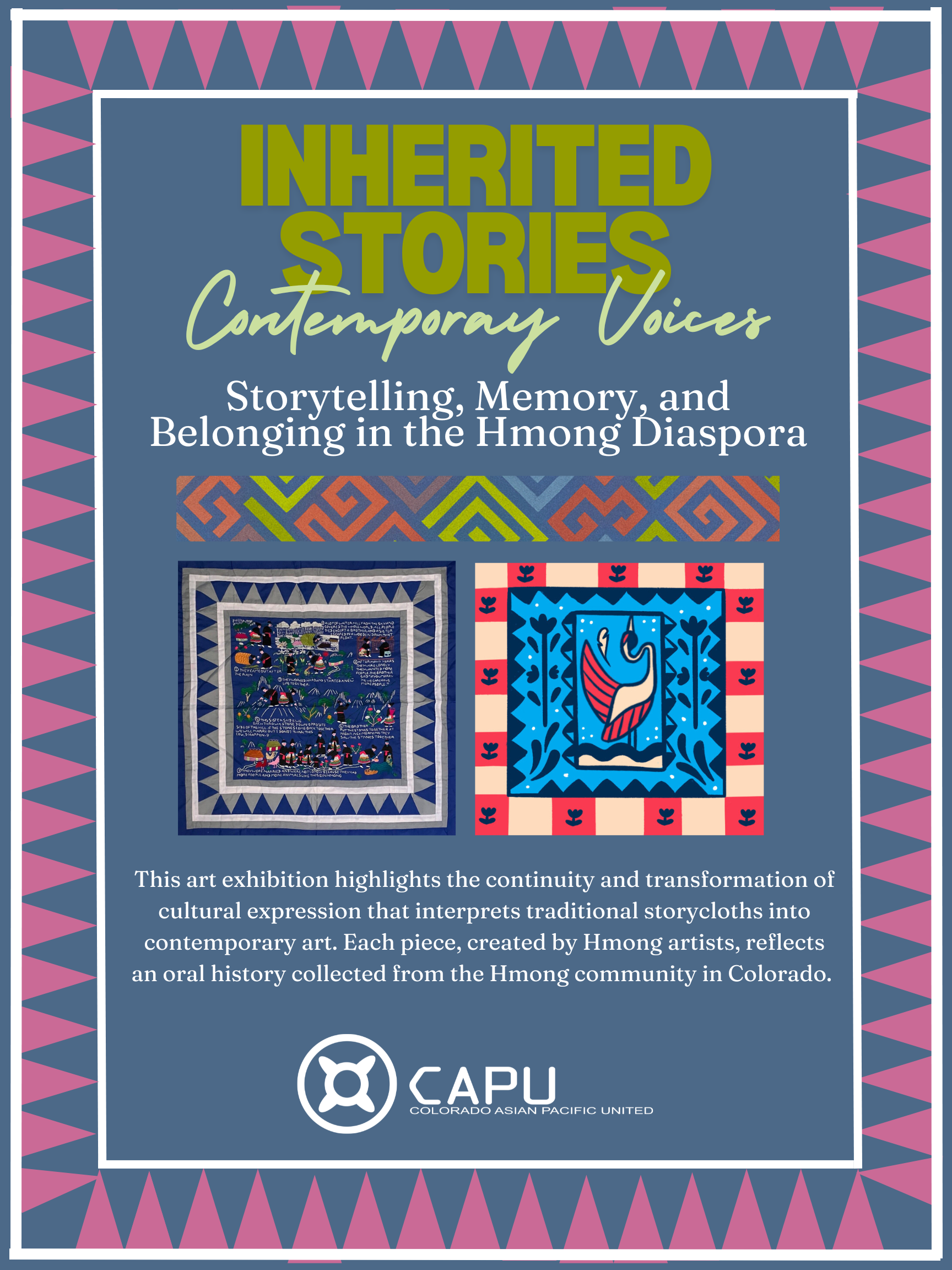
Inherited Stories, Contemporary Voices and Colorado Hmong New Year
Storytelling, Memory, and Belonging in the Hmong Diaspora
Stories are carried across generations, in thread, in voice, and in memory. Beginning in the 1970s, waves of Hmong refugees and immigrants found new homes across the United States, including communities in Colorado. They brought with them traditions, stories, and creativity that continue to shape the cultural landscape today.
Inherited Stories, Contemporary Voices is built on an oral history project that collected the experiences and memories of Hmong individuals in the Denver metro area. Inspired by traditional story cloths- textiles created by the Hmong community to pass on folklore- this exhibition traces how this craft can also be used to create a powerful record of displacement, survival, and identity. Through research, interviews, and collaboration with artists and storytellers, these narratives are reimagined in contemporary story cloth forms including digital illustrations and acrylic paintings.
Developed with Hmong community members, artists, and Colorado Asian Pacific United, the exhibition highlights the continuity and transformation of cultural expression. Each piece reflects the Hmong diaspora journey, celebrating resilience and sharing meaning across time and place. Visitors are invited to reflect on the stories we inherit and the new ones we create, weaving community, history, and culture together.
Special thanks to Colorado Asian Pacific United, Regis University, HMAAC, and the Asian Chamber of Commerce. To the 15 storytellers, thank you for graciously sharing your stories, perspectives and experiences. This exhibit would not be possible without your vulnerability, willingness to participate and encouragement throughout the process.
Spanish: Las historias se transmiten de generación en generación, en forma de hilo conductor, de voz en voz y en la memoria. A partir de la década de 1970, oleadas de refugiados e inmigrantes Hmong encontraron nuevos hogares en todo Estados Unidos, incluyendo comunidades en Colorado. Trajeron consigo tradiciones, historias y una creatividad que continúa moldeando el panorama cultural actual. «Historias Heredadas, Voces Contemporáneas» se basa en un proyecto de historia oral que ha recopilado las experiencias y recuerdos de personas Hmong en el área metropolitana de Denver. Inspirada en los tradicionales tejidos narrativos —textiles creados por la comunidad Hmong para transmitir su folclore—, esta exposición explora cómo esta artesanía también puede utilizarse para crear un poderoso testimonio de desplazamiento, supervivencia e identidad. Mediante la investigación, entrevistas y la colaboración con artistas y narradores, estas narrativas se reinterpretan en formatos contemporáneos de tejidos narrativos, incluyendo ilustraciones digitales y pinturas acrílicas.
Desarrollada en colaboración con miembros de la comunidad Hmong, artistas y Colorado Asian Pacific United, la exposición destaca la continuidad y la transformación de la expresión cultural. Cada pieza refleja la trayectoria de la diáspora Hmong, celebrando la resiliencia y compartiendo significados a través del tiempo y el espacio. Se invita a los visitantes a reflexionar sobre las historias que heredamos y las nuevas que creamos, entrelazando comunidad, historia y cultura. Un agradecimiento especial a Colorado Asian Pacific United, Regis University, HMAAC y la Cámara de Comercio Asiática. A los 15 narradores, gracias por compartir generosamente sus historias, perspectivas y experiencias. Esta exposición no habría sido posible sin su sinceridad, disposición a participar y apoyo durante todo el proceso.
Hmong: Cov dab neeg thiaj li hais ib tiam rau ib tiam neeg, txoj kev lub, suab, thiab nco. Pib xyoo 1970, nthwv cua cov neeg tawg rog Hmoob thiab cov neeg tsiv teb tsaws chaw pom cov tsev tshiab thoob plaws Tebchaws Meskas, nrog cov zej zog hauv Colorado. Lawv thiaj coj cov kab lig kev cai, dab neeg, thiab kev muaj tswv yim uas txuas ntxiv txhim kho cov kab lis kev cai niaj hnub no. Cov dab neeg qub txeeg qub tes, thiab suab qhia txoj kev cais Hmoob ib leeg dhau ib leeg los mus tag nrho Hmoob hauv Denver ntawm cov zej zog Hmoob kom dhau los ntawm cov lus dab neeg no nthuav qhia yuav ua li cas cov khoom siv tes ua no tuaj yeem siv los tsim cov ntaub ntawv muaj zog ntawm kev hloov pauv, ciaj sia taus, thiab tus kheej. Los ntawm kev tshawb fawb, kev xam phaj, thiab kev koom tes nrog cov kws ua yeeb yam thiab cov neeg hais dab neeg, cov lus piav qhia no tau rov xav dua hauv cov ntaub ntawv dab neeg niaj hnub no sau nrog cov duab kos, duab digital thiab cov duab kos duab acrylic.
Tsim los ntawm cov tswv cuab zej zog, cov ua yeeb yam, thiab Colorado Asian Pacific United, kev nthuav qhia txog lub neej dhau los kev hloov pauv ntawm kev coj noj coj ua. Txhua qhov thiaj tig rav qab Hmoob diaspora, xws li kev zoo siab, ua siab ntev thiab sib qhia lub ntsiab lus thoob plaws lub sij hawm thiab qhov chaw. Cov tuaj saib tau raug caw los xav txog cov dab neeg uas peb tau txais qub txeeg qub tes thiab cov lus uas peb tsim, hauv zej zog, keeb kwm, thiab kab lis kev cai ua ke. Ua tsaug tshwj xeeb rau Colorado Asian Pacific United, Regis University, HMACC, thiab Asian Chamber of Commerce. Rau 15 tus neeg hais dab neeg, ua tsaug rau koj lub siab zoo qhia keeb kwm, kev xav thiab kev paub dhau los. Kev nthuav qhia zaum no yuav ua tsis tau yog tias tsis muaj koj, txaus siab thiab txhawb nqa thoob plaws hauv cov txheej txheem qhia.
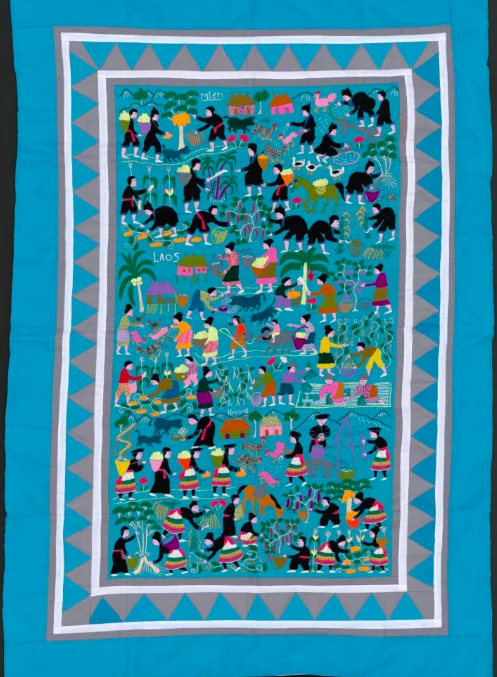
Paj ntaub, directly translated as “flower cloth,” is a traditional Hmong textile art form that carries deep cultural significance and preserves Hmong history and knowledge.
Following the Vietnam War and the Secret War in Laos, thousands of Hmong fled to refugee camps in Thailand. In these camps, women created paj ntaub to document their journeys- embroidered narratives depicting war experiences, displacement, daily life, and folktales as a means of preserving memory, cultural identity, and connection to a lost homeland. As a culture focused on oral traditions to pass on knowledge, paj ntaub are ways to record history and heritage through imagery.
Also known as story cloths, paj ntaub, are typically made on cotton fabric and combine colorful embroidery, appliqué, and other needlework techniques to convey symbolic meanings Motifs often include snail shells, triangles, and roosters which respectively represent marriage, protection, and spiritual connection.
As Hmong communities resettled in the United States, the production of paj ntaub has declined. However, there are growing efforts to preserve historical story cloths, and to teach the tradition to younger generations.
Spanish: Paj ntaub, que se traduce literalmente como "tela de flores", es una forma de arte textil tradicional Hmong que tiene un profundo significado cultural y preserva la historia y el conocimiento Hmong.
Tras la Guerra de Vietnam y la Guerra Secreta en Laos, miles de Hmong huyeron a campos de refugiados en Tailandia. En estos campos, las mujeres crearon paj ntaub para documentar sus viajes: narraciones bordadas que representan experiencias de guerra, desplazamiento, vida
cotidiana y cuentos populares, como una forma de preservar la memoria, la identidad cultural y la conexión con una patria perdida. En una cultura centrada en las tradiciones orales para transmitir el conocimiento, el paj ntaub es una manera de registrar la historia y el patrimonio a través de imágenes. También conocidos como story cloths (telas narrativas) o paj ntaub, suelen estar hechos de tela de algodón y combinan bordados coloridos, apliques y otras técnicas de costura para transmitir
significados simbólicos. Los motivos a menudo incluyen conchas de caracol, triángulos y gallos que representan, respectivamente, el matrimonio, la protección y la conexión espiritual. A medida que las comunidades Hmong se reasentaron en Estados Unidos, la producción de paj ntaub disminuyó. Sin embargo, cada vez hay más esfuerzos por preservar estos tejidos históricos y transmitir la tradición a las generaciones más jóvenes.
Hmong: Paj ntaub, qhia txog “paj ntaub”, yog ib hom ntawv Hmoob textile art form uas muaj tob heev qhia txog Hmoob keeb kwm thiab kev paub. Tom qab Tsov Rog Nyab Laj nyob Nplog teb, ntau txhiab tus Hmoob tau khiav mus thaj nam tawg rog Thaib teb. Nyob hauv thaj nam tawg rog poj niam Hmoob tau tsim paj ntaub ua txog lub neej uas yog ib txoj hauv kev khaws cia. Kev cai yog ib qho uas yuuav dhau mus kom paub. Paj ntaub yog txoj hauv kev los sau keeb kwm thiab cuab yeej cuab tam khaw tseg thiab xav cia. Paub tias yog dab neeg ntaub, paj ntaub, feem ntau yog ua los ntawm paj rwb ntaub thiab muab cov yeeb yuj paj ntaub, applique, thiab lwm yam kev siv rab koob los qhia cov ntsiab lus Mothifs feem ntau suav nrog cov qwj plhaub, daim duab peb sab, thiab roosters uas sawv cev rau kev sib yuav, kev tiv thaiv, thiab kev sib txuas ntawm sab ntsuj plig. Raws li cov pej xeem Hmoob rov los nyob hauv Teb Chaws Asmeskas, kev tsim paj ntaub
tau poob qis. Txawm li cas lov xij, kev siv zog ntau ntxiv los khaws cov ntaub ntawv keeb kwm, thiab qhia kev coj noj coj ua rau cov tub ntxhais hluas ntxiv.