
Denver’s Historic Chinatown
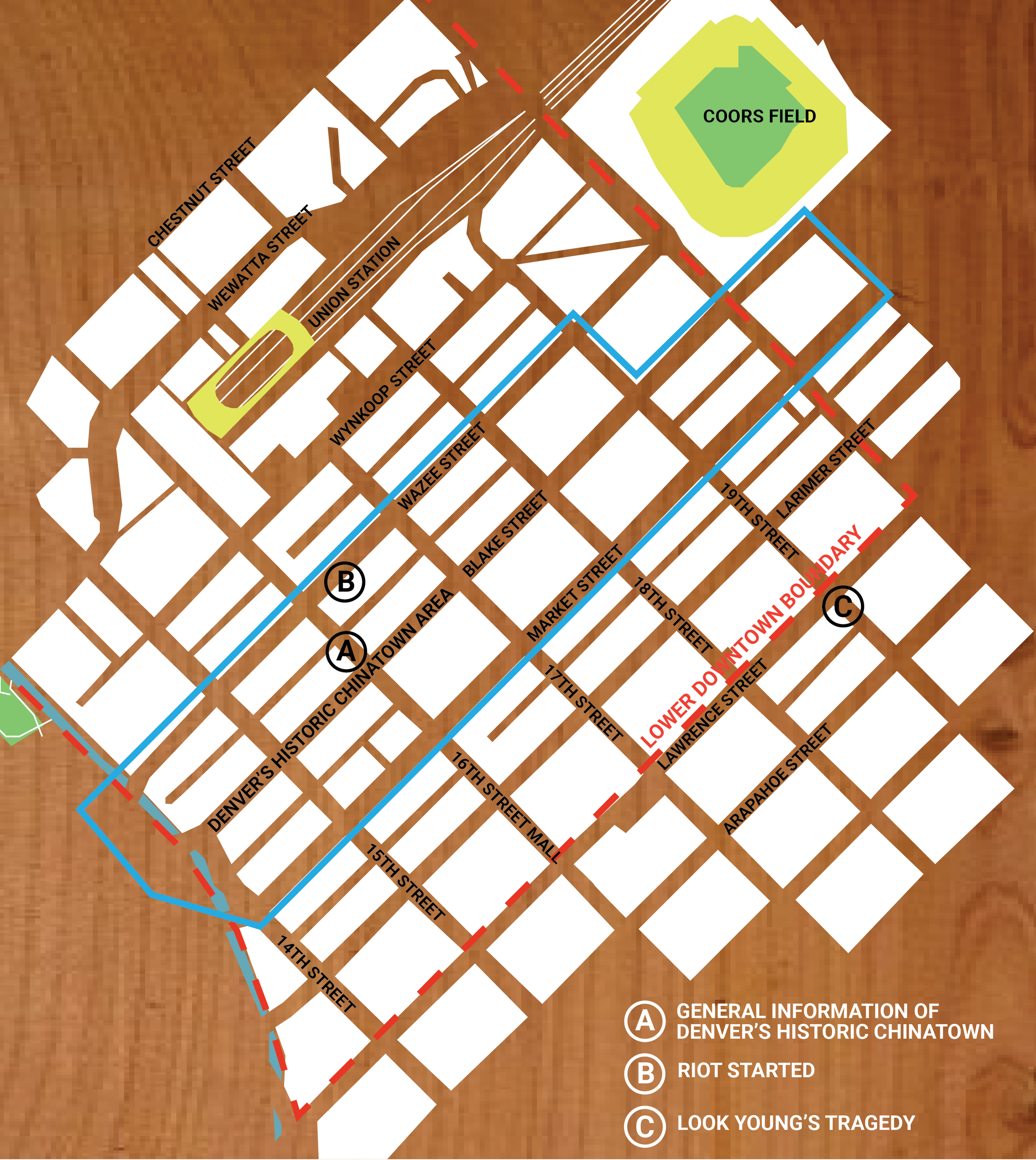
In the late 1800s, Denver was home to the largest Chinatown in the Interior West. A vibrant and thriving ethnic enclave whose main thoroughfare spanned between 15th to 17th Street on Wazee St and all the way to Coors Field depending on the decade. A variety of causes saw to the eventual disappearance of Denver’s Chinatown including Denver’s Anti-Chinese Race Riot of 1880, discriminatory legislation like the Chinese Exclusion Act of 1882, several rounds of urban renewal and rising xenophobia from an unwelcoming society. Today, there is little to no physical evidence of our Chinatown’s existence. Even though thousands of people walk these streets each day, very few of them would be able to recognize the historic significance and diverse history of the area.
CAPU’s work in this storytelling stream includes placemaking, film, exhibitions, formal historical recognition, and advocacy for restitution. In the future, CAPU hopes to revitalize the alleyway that used to be the heart of Denver’s Chinatown. To learn more about our vision to transform the alleyway into a pedestrian-friendly pan-Asian & Pacific Islander gathering space, click here.
Community Partners
-
![]()
Linda Lung
Family and Community Historian
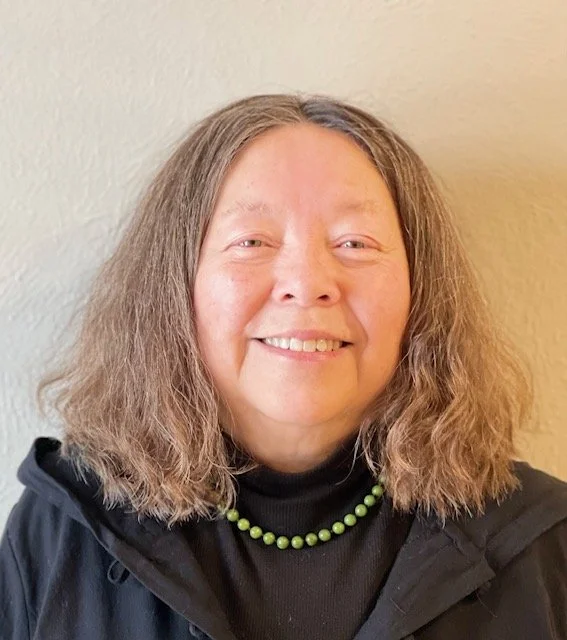
Linda Lung is a native Denverite who worked in the telecommunications and energy sectors for over 40 years. She is currently focusing her energy on capturing the stories of seven generations of the Lung family’s Chinese American history and other Asian American and Pacific Islanders (AAPI) groups to highlight their important roles in Denver’s history. Linda is capturing and preserving these stories for future generations because for too long, these stories have been hidden, ignored, or marginalized. Telling these stories recognizes our shared history and places value on our contributions as a vibrant and thriving community and to fight ignorance, hate and violence against the AAPI community. Linda was instrumental in collaborating with Denver’s Human Rights and Community Partnerships on the documentary “Reclaiming Denver’s Chinatown.” As a member of the Colorado Asian Pacific United (CAPU) storytelling committee she continues to celebrate our rich cultural heritage by capturing stories from community members throughout Denver.
-
![]()
Heather Clifton
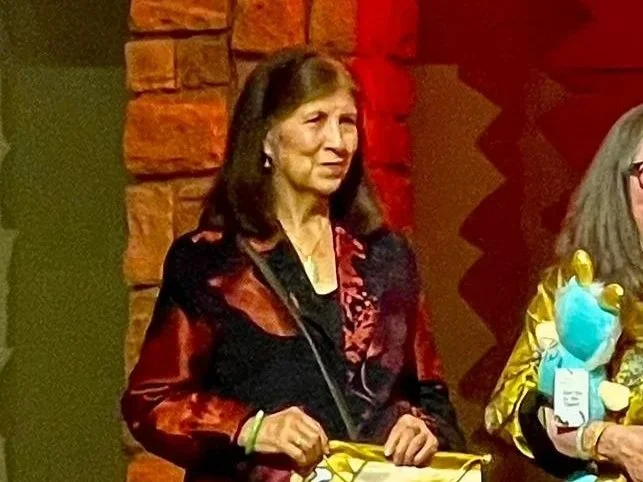
Heather Lung Clifton began her career in the field of education. She spent more than thirty years in the public schools as a teacher, curriculum and professional development specialist, and an elementary school principal. For the past fifteen years she has served schools and other organizations in both the public and private sectors as a consultant and facilitator in various aspects of school reform, organization and professional development, cultural diversity training, and community development.



Denver’s Apology
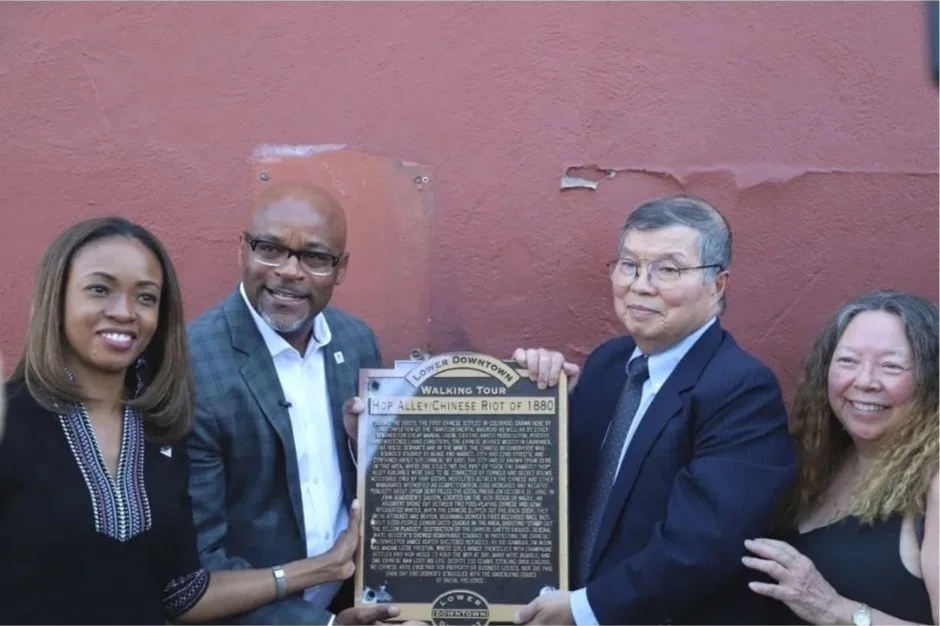
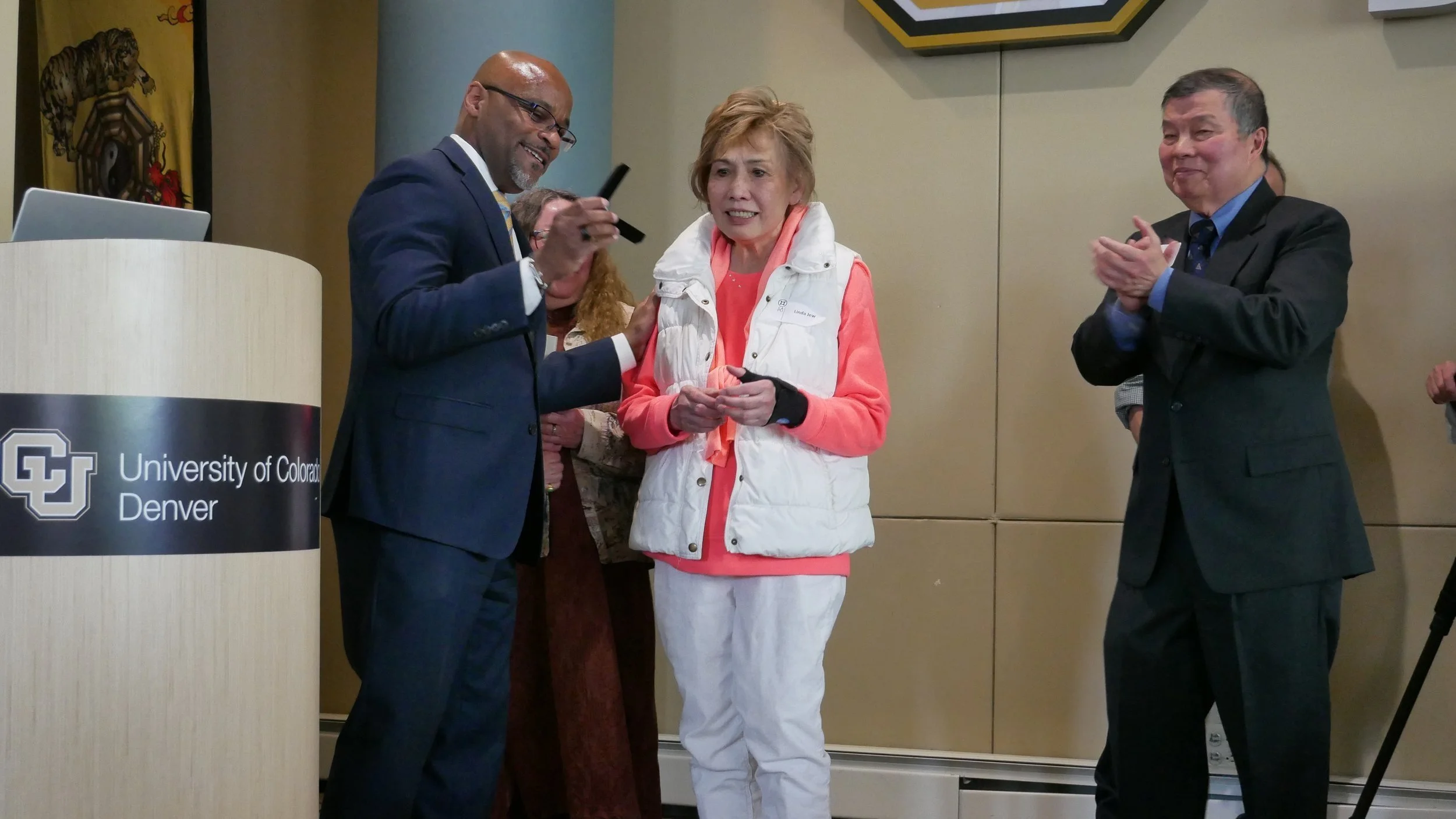
For years the only physical marker of Denver’s Chinatown was a plaque in Lower Downtown with racist and inaccurate language. Looking to bring justice to the Chinese community, and ensure this history was not forgotten, CAPU spent several months advocating for the plaques’ removal and proper recognition from the city. In 2022, CAPU secured an official apology from Mayor Michael Hancock on behalf of the City of Denver for the mishandling of the 1880 Anti-Chinese Race Riot and widespread systemic discrimination against Chinese immigrants. The apology was received by the Lung and Chin families, some of the only known existing descendents from Denver’s Chinatown. This was the first apology of its kind outside of California, and fifth in the entire nation. Widely covered across the country, this event sparked nationwide interest and led to the eventual removal of the erroneous plaque in 2023.
Denver Chinatown Curriculum
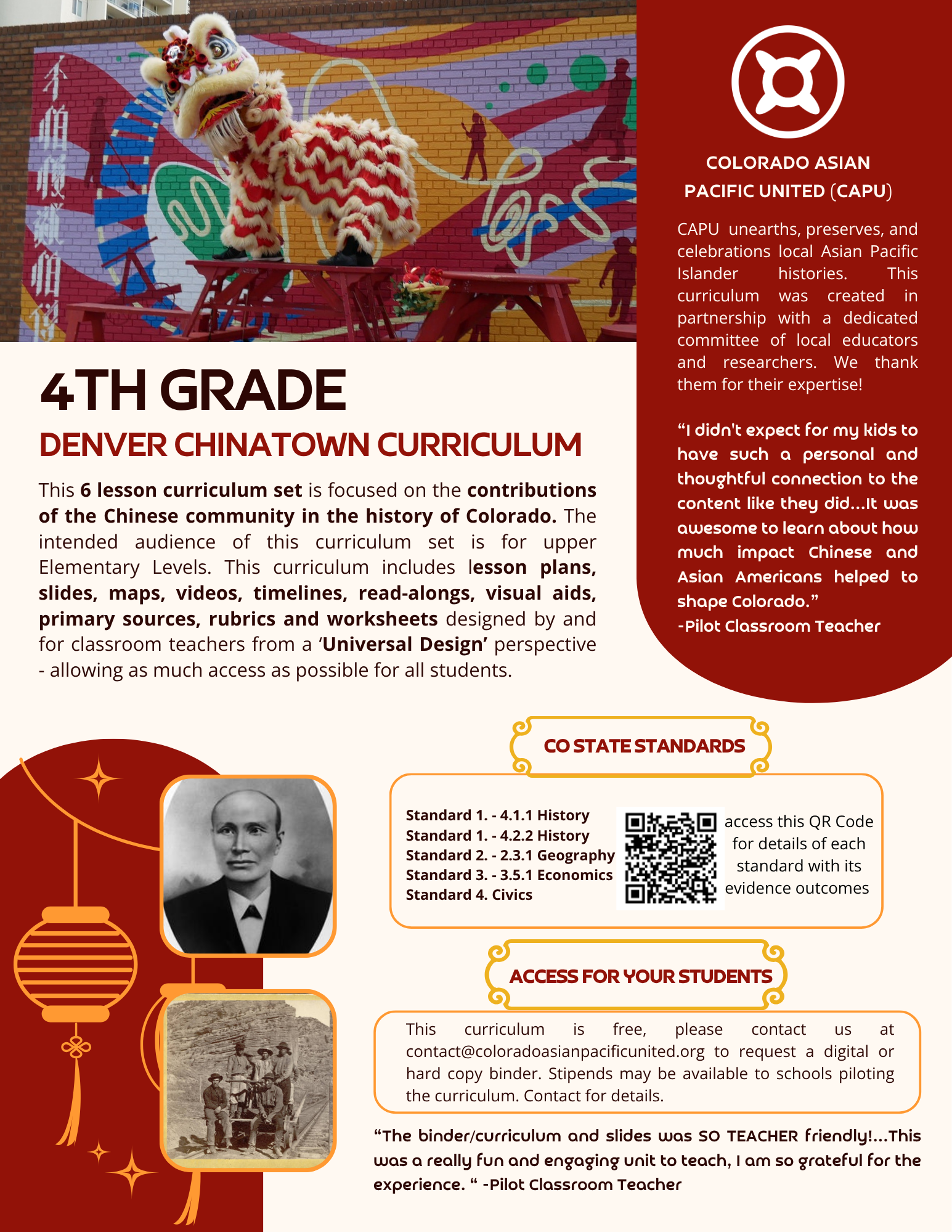
CAPU worked with a volunteer group of teachers, researchers, and academics to develop a curriculum for upper elementary classrooms about Denver’s Chinatown. This free lesson curriculum set is focused on the contributions of the Chinese community in the history of Colorado. This curriculum includes standards-aligned lesson plans, slides, maps, videos, timelines, read-alongs, visual aids, primary sources, rubrics and worksheets designed by and for classroom teachers from a ‘Universal Design’ perspective - allowing as much access as possible for all students.
“I didn't expect for my kids to have such a personal and thoughtful connection to the content like they did...It was awesome to learn about how much impact Chinese and Asian Americans helped to shape Colorado.” -Pilot classroom teacher
This curriculum is free, please submit your email below to access. Reach out to Contact@coloradoasianpacificunited.org for support.
Reclaiming Denver’s Chinatown Documentary
Over the course of a year and a half, filmmakers Rowena Alegria, Emily Maxwell and Roxana A. Soto from the Denver Office of Storytelling, spent time with the Lung and Chin families and CAPU to collect family' stories, photos and artifacts, as well as historical context and efforts to reclaim this history.
Their work resulted in a 50- minute documentary "Reclaiming Denver's Chinatown" that first premiered at the Denver Film Festival in November 2022.
Murals and Historical Markers
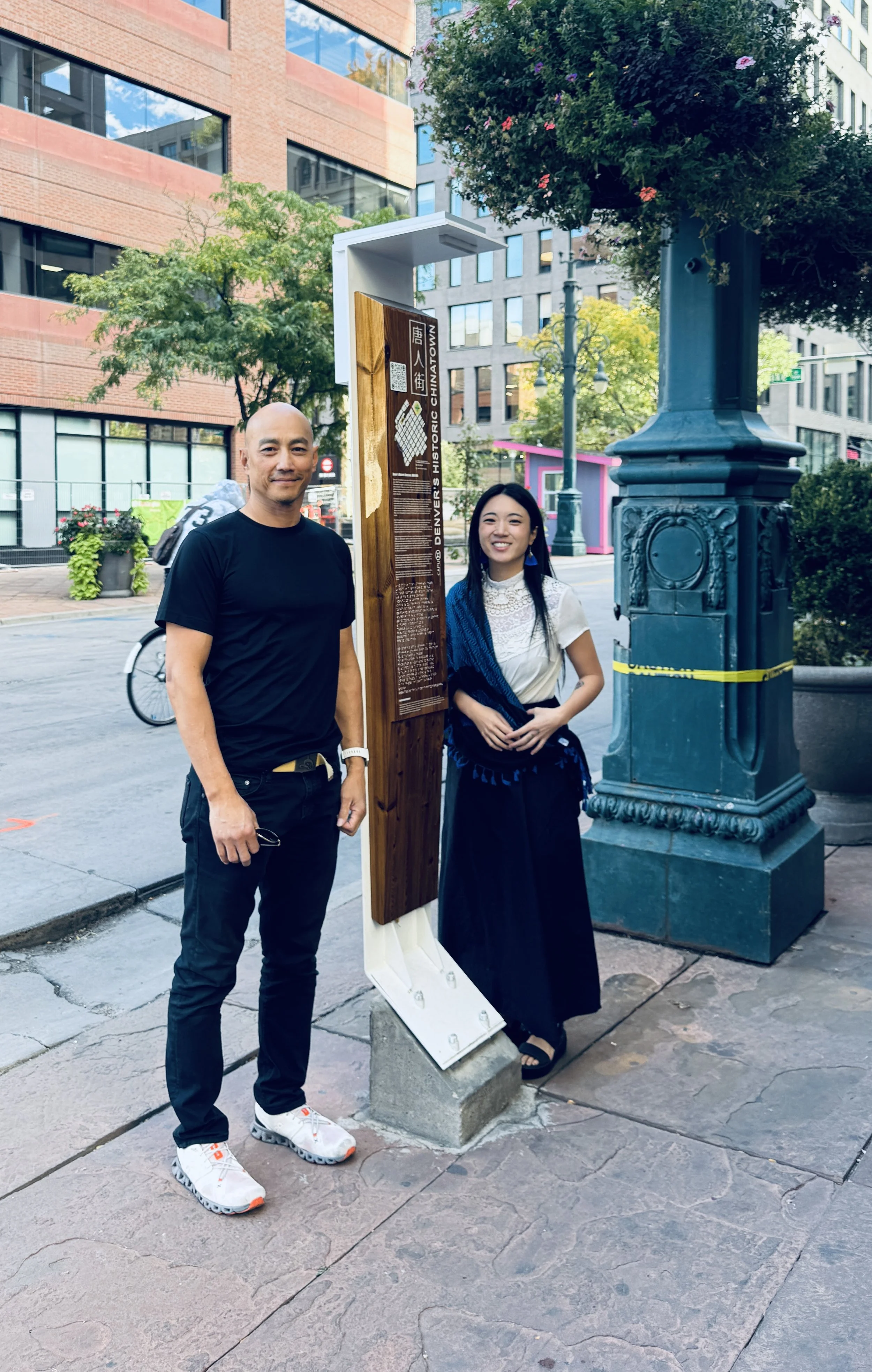
In an effort to physically and metaphorically reclaim the space of Denver’s Historic Chinatown, CAPU installed two murals and three historical markers strategically across Downtown Denver to honor our stories.
-
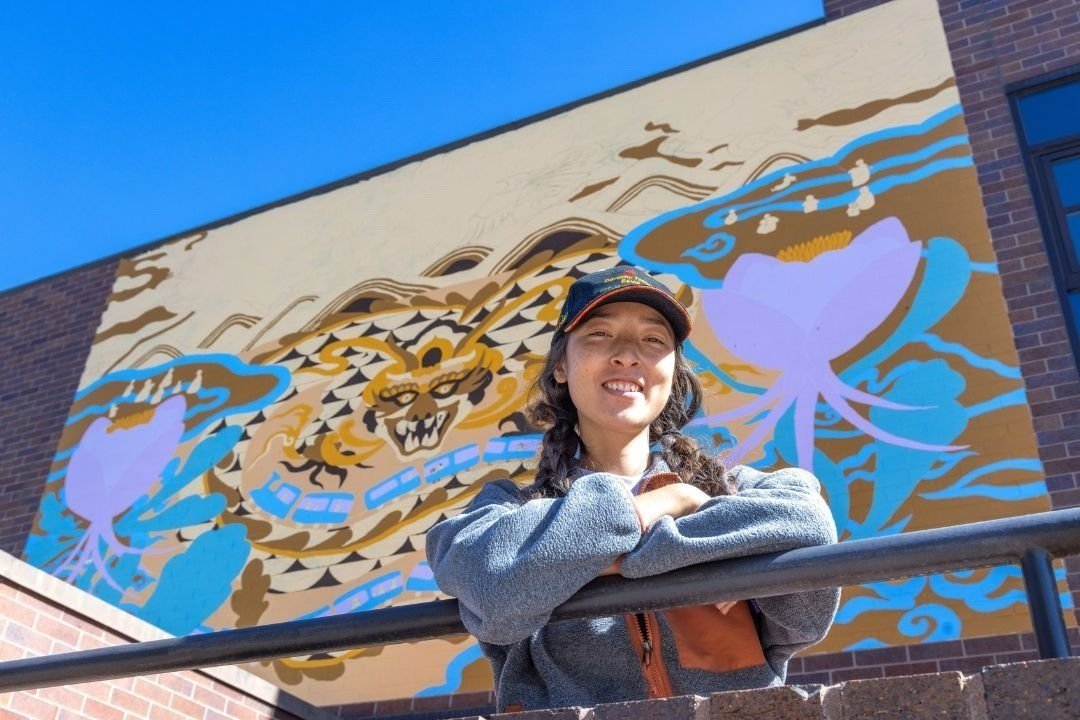
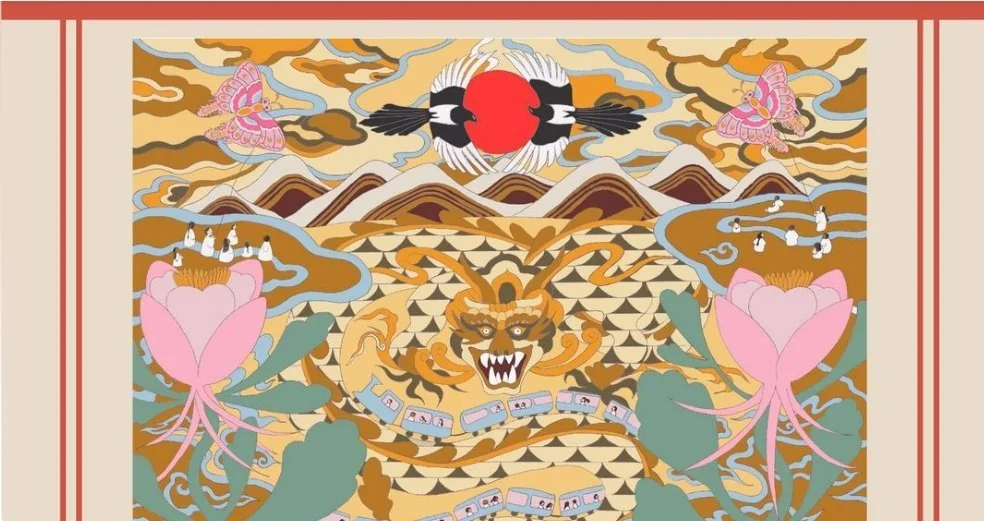
Cory Feder, a Korean American artist based in New Mexico but who grew up in Colorado, was selected by CAPU to paint the mural. Her mural illustrates movement and migration by Asians and Asian Americans.
Read below for her artist statement:
“This design is inspired by K’ossu imagery which was often woven with silk. I took my inspiration from textile design in particular after learning that much of the men in Denver’s Chinatown found success operating laundry businesses after finishing their work on the railroad in the west. The train appears in this design as well but there is no apparent ending to its length, showing the legacy left behind by our past Asian community as well as the promise of what is to come in the future. The Colorado landscape is referenced by Columbine flowers, the Rockies and of course magpies which are not only present in Denver but are beloved in Korean folklore, creating a bridge between the homeland and our new home.
The dragon is not only an important symbol of strength and resilience but to me is a symbol of the living vibrancy of today’s Asian community in Denver as we now honor the river dragon once a year through Dragon Boat Festival. The unmoving spirit that is seen in the face of the dragon is necessary in this courageous step for the history of the AANHPI community of Denver to become visible in its reclamation.
The presence of the kites in this drawing are not only references to the stories mentioned earlier but are my favorite symbol for the diaspora. As the kite flies into the unknown territory of the sky, they are still anchored by the hands that hold them on the mainland.”
-
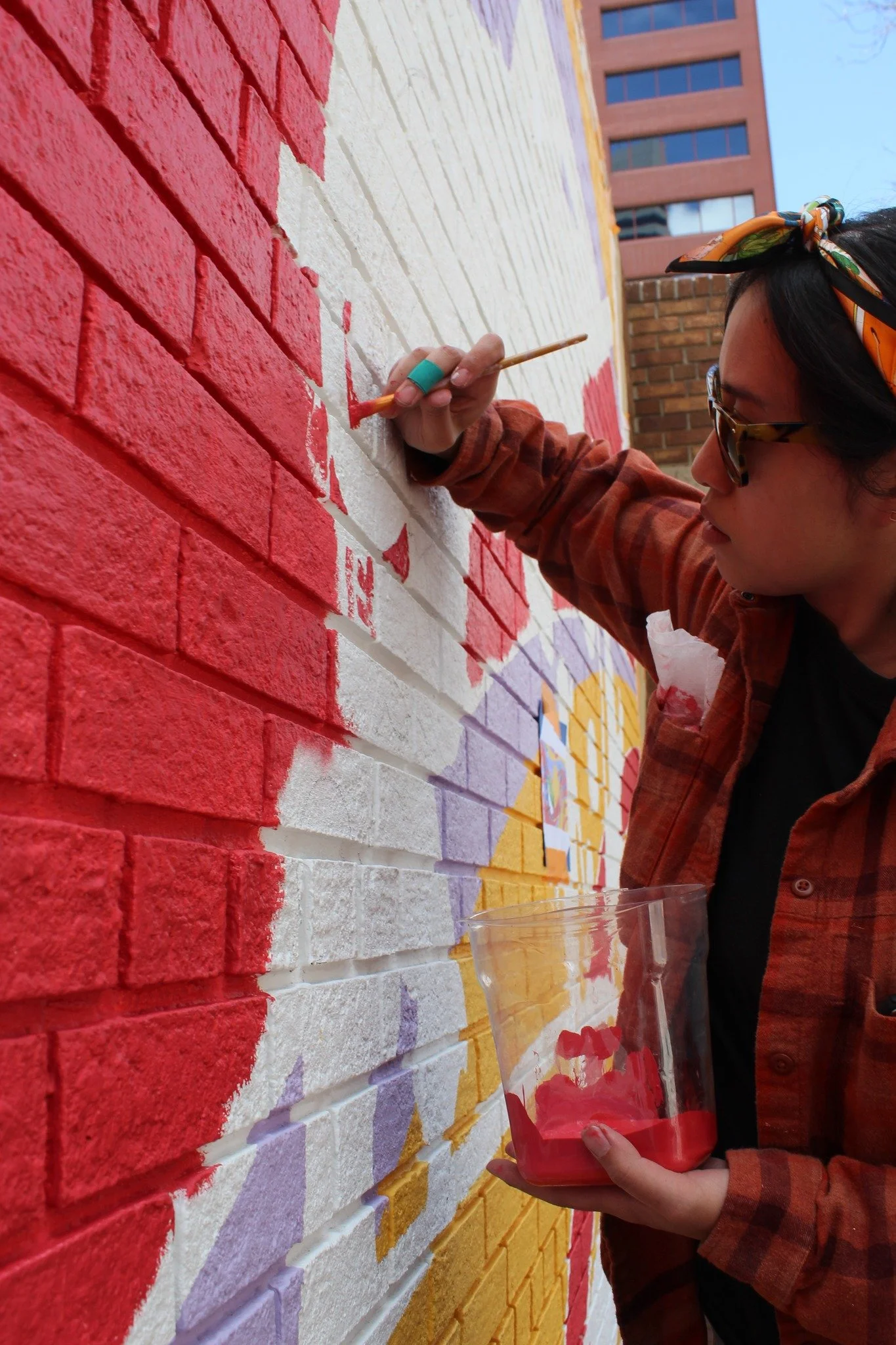
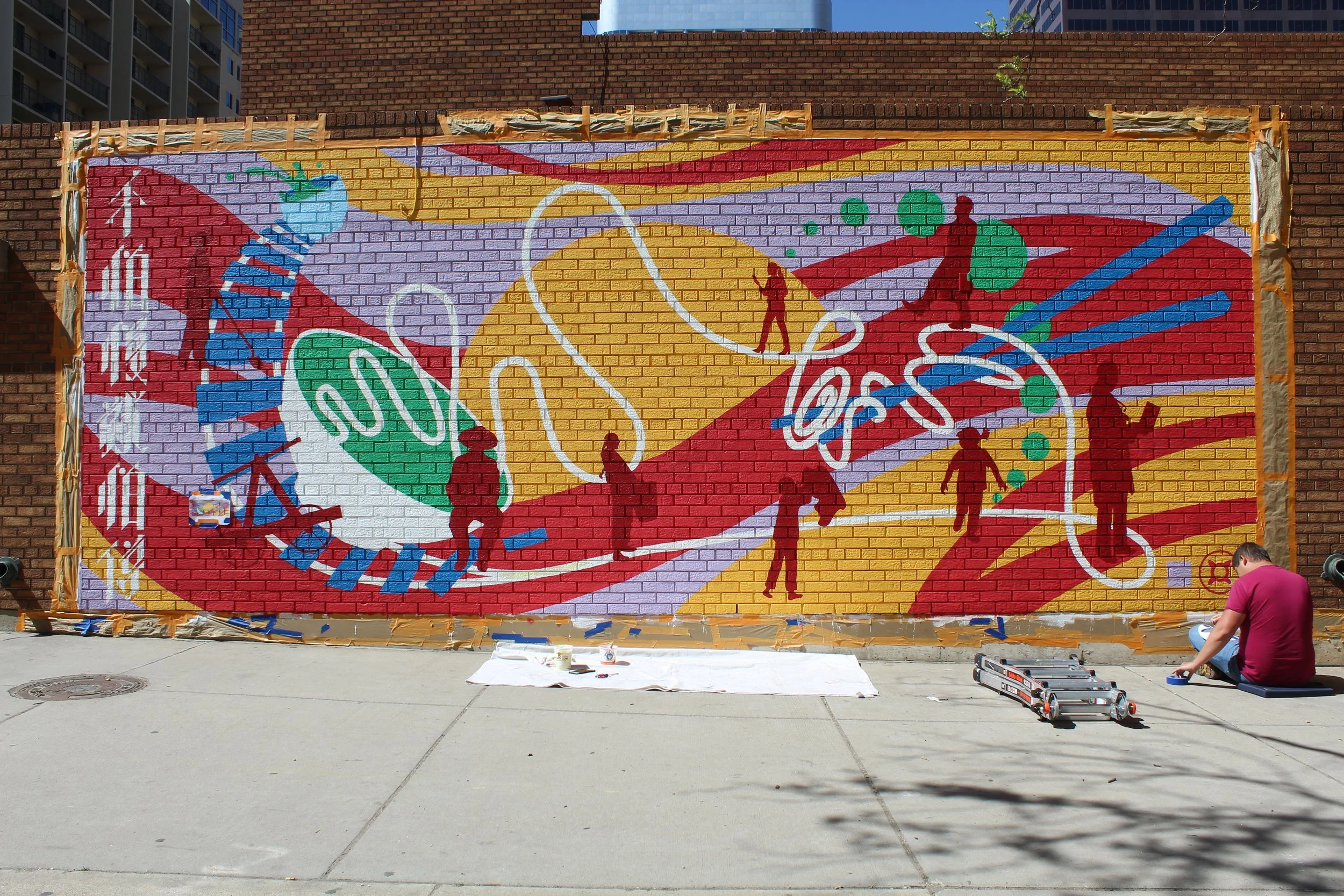
Nalye Lor installed the beautiful Chinatown mural on 1890 Lawrence Street to celebrate the resilience of the Chinese immigrants. Read below for her artist statement:
“They say that a picture paints a thousand words, and I have always thought that to be such a magical skill to possess. What I didn't know how to convey with words, I could accomplish through drawings. Because of this, I have always been enchanted with visual storytelling since I was young. Through my art, I have always sought to create that connection between stories and people—between what can be seen and what can be felt. My creative journey has been an exploration of the fantastical people and mesmerizing worlds beyond the horizon, with my goal to paint those thousands of words.
The story of Denver's historic Chinatown was important, as is the inclusion of the present and tomorrow's future. I intend for this mural to encapsulate all of that, and to spark wonder in the viewer to learn this story more in depth. Part of my creative process is to immerse myself in the moment, following what feels right and letting intuition guide my hand. This led to the endless movement throughout the mural. In this particular piece, I strived to cultivate interest from the public eye through that line movement, utilizing bright colors to draw attention to the details. There is boundless beauty that surrounds us, full of life and rich cultures that have been unfolding for centuries, many of which are unheard of. I think art is a wonderful and powerful way to not only tell these stories, but to share them with others.”
-
Denver's Chinatown was one of the largest and most prosperous of the over 200 Chinese communities that once existed in the American West. Chinatown’s origins can be traced to an anonymous Chinese immigrant who arrived in Denver in June 1869. He was probably one of the Chinese railroad workers primarily responsible for building the western half of the famous Transcontinental Railroad that unified the country economically and culturally.
Chinatown was located on Wazee Street between 15th and 17th Streets, extending up to 22nd Street. It was a flourishing frontier community that provided a wide range of ethnic goods and services in a welcoming environment to Chinese immigrants working in Colorado and the Intermountain West. The Chinese immigrants performed mainly physical labor, such as working in mines and building infrastructure. Eventually, they were relegated to marginal livelihoods such as laundrymen and cooks.
Even though there were comparatively few Chinese residents, the local white population perceived them as an economic and cultural threat. Chinese encountered racial hostility and were denied civil rights, economic opportunity, and social equality. This hostility gave rise to “The Chinese Question,” a national controversy over whether Chinese laborers should be allowed to immigrate to the United States.
Local antagonism led to Denver’s anti-Chinese race riot. On October 31, 1880, an estimated 3,000 to 5,000 Denverites descended upon Chinatown to rape and pillage. During the mob’s rampage, they lynched and beat a laundryman named Look Young to death. Though the murderers were brought to trial, they were acquitted of the crime. Despite continued tensions, most of the Chinese community remained to rebuild Chinatown.
National laws preventing Chinese immigrants from establishing families in America and even entering the country sounded the death knell of Denver's Chinatown. Adding insult to injury, Denver’s anti-Chinese riot was cited as one of the reasons why the US Congress enacted the disreputable Chinese Exclusion Act (1882) to ensure social stability. In other words, they blamed the victims for their victimization.
Since the end of World War II, Chinese and other Asian Americans have returned to Denver to live and work. With ethnic enclaves like Little Saigon and Sakura Square, the Asian American community continues to thrive.
-
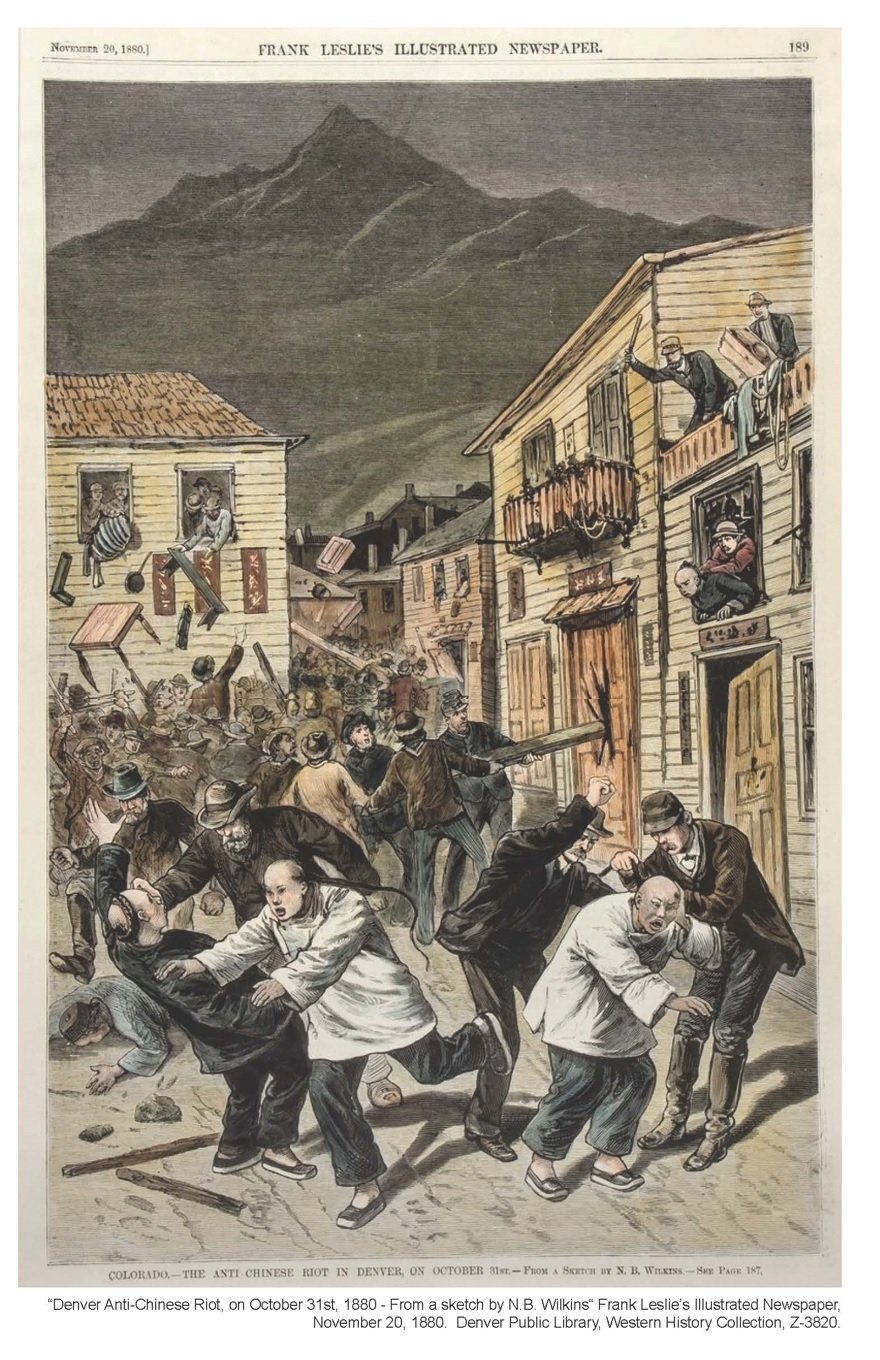
Denver’s first race riot occurred on October 31, 1880. It started when several drunken white men entered John’s Place, a saloon located in what is now 1620 Wazee Street, where they began to harass two Chinese men playing pool, hitting one without provocation. Upon hearing of the fight, a mob estimated to be between three to five thousand, approximately 10 percent of Denver’s population, descended upon Chinatown to rape and pillage. The rioters sought to destroy the community and drive out its 450 residents. During the mob’s rampage, they lynched and beat a laundryman named Look Young to death. Though severely damaging Chinatown and seriously injuring many of its inhabitants, the rioters failed to force them out of Denver. Most Chinese Denverites remained to rebuild their community. They refused to be driven from their homes.
However, national laws preventing Chinese immigrants from establishing families in America and even entering the country sounded the death knell of Denver's Chinatown. Ironically, Denver’s anti-Chinese riot was cited as one of the reasons why the US Congress enacted the infamous Chinese Exclusion Act (1882) to ensure social stability. It was extended ten years later and then made permanent in 1902. When China was an American ally during World War II, Congress repealed the exclusion laws in 1943 and allowed 105 Chinese to immigrate to America. It also permitted some Chinese immigrants living in the United States to become naturalized citizens, though they were still denied property-ownership rights.
Denver’s anti-Chinese riot was one of the worst episodes of ethnic cleansing that befell the Chinese in the Interior American West. The Honorable Mayor Michael B. Hancock issued a proclamation designating October 31, 2020, as Denver’s Chinatown Commemoration Day to memorialize the 140th Anniversary of the anti-Chinese riot. On April 16, 2022, Mayor Hancock signed a letter to officially apologize to Chinese immigrants and their families for failing to protect them from the rioters. Denver is the fifth city in the United States to apologize for its history of anti-Asian discrimination and violence, and the first outside California to do so.
As with other Chinese immigrants, all Look Young (陸揚,Lu Yang in Mandarin) wanted was to make a living and support his family in China. He was a native of Hock Sun, one of the five counties of the Pearl River Delta, Southern Guangdong Province. This region saw countless Overseas Chinese migrate to North America, Southeast Asia, and Australia. Like most Overseas Chinese who immigrated to America at the time, Look Young probably worked as a laborer to build the infrastructure that made the American West inhabitable. Despite their contributions to the country’s development, he and most of his fellow compatriots were eventually relegated to the margins of the American economy to work as laundrymen or cooks
-
Look Young had worked in the United States for four and half years and in Denver for only six months before becoming a casualty of the city’s anti-Chinese riot on October 31, 1880. He was only twenty-eight years old when his life was tragically cut short. Look Young’s quest for the “American Dream” ended with an “American Nightmare.” Rioters caught him at his place of work, Sing Lee’s laundry, tied a rope around his neck and dragged him along Arapahoe Street toward 18th Street. The mob shouted, “cut off his queue, cut off his nose.” His tormenters tortured him, then hung him from a lamp post. The physicians who tried to save him had never seen such a horrifically mutilated body with such massive injuries, including ruptured blood vessels in his brain through blunt-force trauma. Look Young died from his injuries, leaving his wife, mother, and father behind in China. His death jeopardized his family, for they depended on him for their survival.
James Corrigan, Edward Troendle, Frederick Miller, and William Krueger were brought to trial for beating and kicking Look Young to death. Despite having eyewitnesses to this heinous crime, the jurors found them “not guilty.” As has happened many times in American history up to the present day, perpetrators of racial violence often escape justice.
The Honorable Mayor Michael B. Hancock issued a proclamation designating October 31, 2020, as Denver’s Chinatown Commemoration Day to memorialize the 140th Anniversary of the anti-Chinese riot and the murder of Look Young. On April 16, 2022, Mayor Hancock signed a letter to officially apologize to Chinese immigrants and their families for failing to protect them from the rioters. Denver is the fifth city in the United States to apologize for its long history of anti-Asian discrimination and violence. Denver is the fifth city in the United States to apologize for its long history of anti-Asian discrimination and violence, and the first outside California to do so.
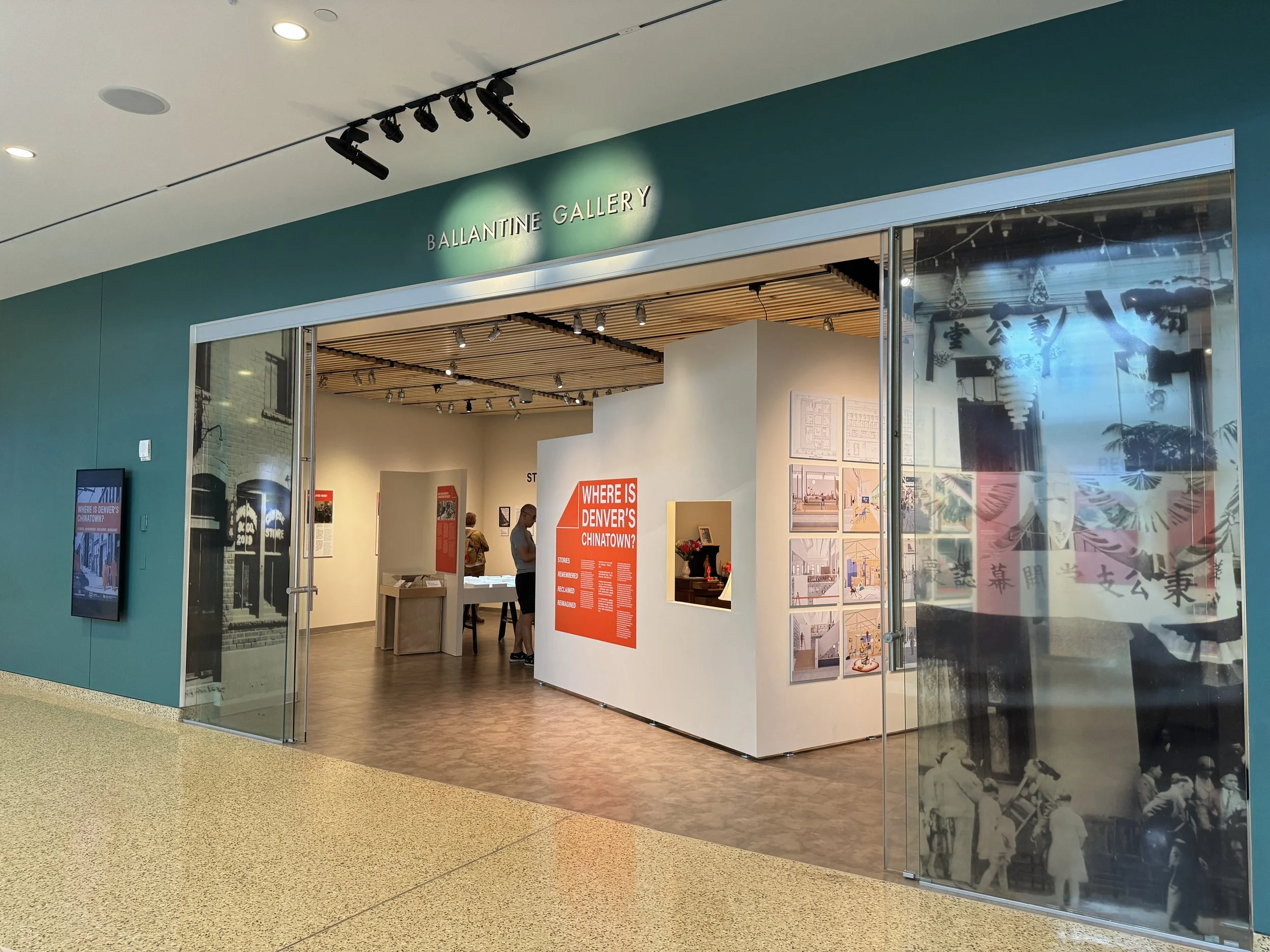
‘Where’s Denver’s Chinatown?’ Exhibit
In partnership with History Colorado, CU Denver’s College of Architecture and Planning, and the Lung and Chin families, CAPU helped lead a co-curatorial process to implement the exhibition, Where is Denver’s Chinatown? Stories Remembered, Reclaimed, Reimagined. This project explored the history and resilience of Denver’s Chinatown through historical artifacts, personal familial narratives, architectural recreations, and student projects re-envisioning what a new Chinatown could look like. Juxtaposing the challenges this immigrant community faced with the private, interior life of the families encouraged audiences to view the history through a humanizing and personal lens.
On view from October 9, 2024 through September 1, 2025, the exhibition was extended due to its popularity, and hosted over 24,000 attendees during its run. The unique co-curatorial process that centered the communities most impacted was featured at the 2024 Colorado Wyoming Association of Museums.
Historic Chinatown Animated Photos
In 2026, we worked with local animation artist Maddy Santamaria and descendant families to create a new way to step into Denver’s lost Chinatown. The animated historic photos, including several shared by the descendants of Denver’s Chinatown for the first time, premiered at Colorado Dragon Boat Film Festival as a VR goggle pop up.
We continue exploring ways to bring history to life using new technology. If you are interested in the VR experience, please email contact@coloradoasianpacificunited.org
Special thanks to Linda Lung, Heather Clifton, and Lisa Burkhart for stewarding your families stories all these years and sharing them with us
Partners
We could not have done any of this work without our funders and partners.
Denver Arts & Venues
Andrew Mellon Foundation
HDR, Inc
Front Range Research Associates
State Historical Fund
History Colorado Museum
CU Denver Architecture and Planning